
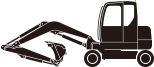





The difficulty in selecting equipment for deep foundation excavation often does not lie in the single figure of "maximum digging depth." The deeper the foundation pit or pile cap, the more the equipment must complete vertical digging, full-bucket lifting, swing positioning, and dumping to trucks within a confined space, while also facing constraints from pit-edge soil, temporary road bearing capacity, and continuous shifts. Selecting a machine solely by maximum depth easily overlooks the interplay among dump height, swing radius, and ground conditions.
This article uses verified data for the SH500 (a 50-ton class crawler excavator with an operating weight of 49,600 kg) as a reference to explain how to break down operational requirements for deep foundation excavation, which parameters correspond to these requirements, and which conditions still require on-site verification.
First Break Down Operational Objectives: Four Aspects of Deep Foundation Excavation
Deep foundation construction includes different stages such as foundation pit excavation, soil removal for pile caps or raft foundations, and soil clearing between piles. Those directly related to equipment selection can be summarized into four items:
- Digging depth and verticality: Whether the design elevation can be reached within the support structure and excavation accuracy near the pit wall can be maintained.
- Lifting and dumping: After lifting a full bucket from the pit bottom to the pit opening, whether it can directly align with the truck bed to reduce rehandling.
- Swing and working radius: Whether there is enough swing space between the equipment position and the pit edge, soil stockpile area, and truck passage.
- Site and continuous operation: Ground bearing capacity at the pit edge, track ground pressure, shift continuity, and refueling arrangements.
These four items are not a parallel parameter checklist but have a sequence: depth determines whether the equipment can cover the working face, dump height determines whether soil can be loaded onto trucks in one pass, and radius and bearing capacity determine whether the equipment can be positioned safely and operate continuously.
Depth and Vertical Excavation: What Else to Consider Beyond Maximum Digging Depth
In the SH500 data, the maximum digging depth is 7,800 mm, and the maximum vertical digging depth is 7,086 mm. The difference between the two values is that the vertical digging depth is less than the maximum digging depth, indicating that when maintaining vertical digging near the pit wall, the actual achievable depth is limited by the arm and bucket posture. If deep foundation excavation requires vertical soil removal close to the support structure, the vertical digging depth should be used as the reference rather than directly applying the maximum digging depth.
At the same time, the maximum digging height of 10,924 mm and maximum digging radius of 12,016 mm affect the equipment's coverage area at the pit edge. When the foundation pit plan dimensions are large, the equipment may need multiple repositioning or sectional excavation, which must be arranged on site in conjunction with temporary roads at the pit edge and the support form; the data itself cannot replace site planning.
Dump Height and Truck Positioning
Soil from deep foundation excavation usually needs to be lifted from the pit bottom to the pit opening and then loaded onto trucks for transport. The SH500's maximum dump height is 7,615 mm. This value corresponds to the height the bucket can reach in the dumping posture. Whether it can smoothly align with the truck also depends on the truck bed height, the equipment position, and the height difference between the equipment and the truck parking position. If the truck is parked on the ground at the pit opening and the equipment stands at the pit edge, the dump height needs to cover the top edge of the truck bed and leave an operating margin; if temporary soil stockpiling at the pit edge followed by secondary loading is adopted, the stockpile height and loading equipment coordination must be evaluated separately.
The data does not provide matching conclusions for different truck models. Before purchase, the truck bed height, parking method, and pit opening height difference should be included in the checklist.
Working Radius and Swing Space
The SH500's maximum digging radius is 12,016 mm, maximum ground-level digging radius is 11,814 mm, tail swing radius is 3,655 mm, and minimum front swing radius is 4,825 mm. Around deep foundation pits, there are often supports, dewatering wells, temporary roads, and material storage yards, so the area swept by the tail during swing must be reserved in advance. The tail swing radius of 3,655 mm corresponds to a reference for the minimum safety distance on one side; actual layout must also consider counterweight ground clearance, platform width, and on-site obstacles.
If the foundation pit plan dimensions are small and the pit-edge road is narrow, working radius and swing space may become limiting conditions earlier than digging depth. Such cases require on-site layout verification and cannot be judged solely from the parameter table.
Site Bearing Capacity and Continuous Operation Conditions
The SH500 has an operating weight of 49,600 kg, and the ground pressure is listed in the data as 81.9 MPa. The unit and magnitude of this value need further confirmation from the manufacturer or technical documentation and should not be directly converted or compared with common ground pressure units; its definition and test conditions should be verified before purchase. Regardless, when a 50-ton class machine travels and operates at the pit edge, there are requirements for temporary roads, pit-edge soil, and loads on top of supports, and bearing conditions should be confirmed by geotechnical or construction plan specialists.
For continuous operation, the SH500 is equipped with a 650 L fuel tank, 350 L hydraulic tank, and 406 L hydraulic system capacity, with travel speeds of 3.2/5.3 km/h and gradeability of 70% (35°). These data can be used to evaluate refueling and transfer arrangements within a shift, but actual fuel consumption and working cycles are affected by materials, operation, and working conditions. The data does not provide conclusions on shift productivity or fuel consumption, and cost savings cannot be inferred from it.

What Operating Conditions Do Power, Hydraulics, and Digging Force Correspond To?
The SH500 is equipped with a Cummins QSM11 engine with rated power of 250 kW/2000 rpm and displacement of 11 L; the hydraulic system is a Linde load-sensing system with maximum operating flow of 2×380+27 L/min. Bucket digging force is 290 kN, arm digging force is 236 kN, and bucket capacity is 2.2–2.5 m³. For dense sand, gravel, or weathered rock layers common in deep foundations, digging force and hydraulic flow affect penetration into materials and response of combined operations; however, whether the material can be excavated directly also depends on the geotechnical category and whether breaking or support coordination is required. The data does not provide conclusions on stratum applicability.
If deep foundation work encounters hard rock or concrete structures that require breaking, a hydraulic breaker is a supporting solution. Whether the carrier and attachment match must be separately verified based on operating weight, hydraulic flow and pressure, attachment weight, connection dimensions, and piping data; this article does not draw compatibility conclusions.
Situations Requiring Cautious Judgment
- When the foundation pit depth approaches or exceeds the maximum vertical digging depth and vertical soil removal close to the support is required, the equipment posture and excavation layering should be reviewed on site.
- When the truck bed is high or the pit opening height difference is large, whether the 7,615 mm maximum dump height is sufficient must be calculated according to the actual parking method.
- When the temporary road at the pit edge has insufficient bearing capacity or the top of the support does not allow heavy equipment to approach, a 50-ton class machine may not be suitable, and the positioning or staged excavation plan should be adjusted.
- The unit and definition of the ground pressure value have not been confirmed and cannot be used directly for bearing capacity calculations.
Conditions Recommended Before Inquiry
When communicating with the equipment supplier, it is recommended to prepare: foundation pit plan dimensions and depth, support form, main soil layer description, truck model and bed height, pit-edge road and bearing conditions, daily work shifts and refueling arrangements, and whether breaker attachment coordination is required. The more specific these conditions are, the easier it is to check whether the working range parameters correspond to on-site constraints. Whether the equipment is suitable should still be subject to confirmation after on-site survey and construction plan review.