






Port bulk material stockyards and mine rock stripping both use crawler bulldozers, but the two face different materials and site conditions, and their requirements for equipment configuration also differ. Port coal yards are dominated by loose bulk materials, with operations including dozing, stockpiling and site leveling; blade capacity and wear resistance affect efficiency. Mine stripping faces rock materials and weathered rock, with high dozing resistance and higher requirements for blade strength, push arm assembly and undercarriage rigidity. Selecting only by tonnage or engine power can easily overlook these configuration-level differences.
This article uses verified data on the SD32 series bulldozers as reference to explain the trade-off basis for equipment configuration in the two types of operations, and the site conditions that need to be confirmed before inquiry.
Condition differences between the two types of operations
The typical environment for port bulk material dozing is a coal yard, power plant stockyard or bulk material transfer area. The material is loose and highly flowable, and dozing resistance is relatively low, but the working area is large and dozing distances may be long, requiring frequent travel and steering. Bulk material stockyards usually also have environmental and site cleanliness requirements; blade shape affects whether material tends to spill during dozing.
The working face in mine stripping is rocky soil, weathered rock or blasted crushed stone. The material has large lump size and high dozing resistance, the blade bears greater impact when cutting in, and the push arm assembly and blade edge wear faster. The working face may be uneven, and the undercarriage and travel system bear more impact.
What the two scenarios share is the need for continuous operating capability and a stable undercarriage, but the emphasis differs: port bulk material values blade capacity, wear resistance and travel flexibility more; mine stripping values blade structural strength, undercarriage rigidity and protective configuration more.
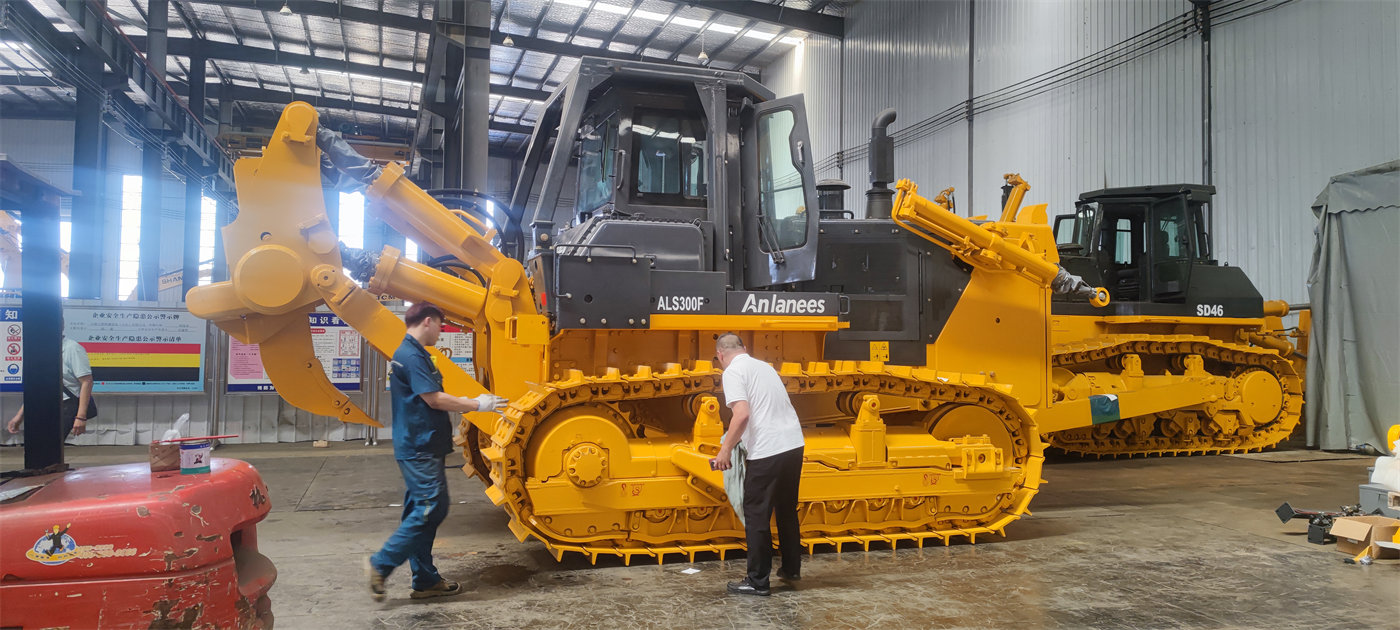
Configurations in the SD32 series corresponding to the two scenarios
The SD32 series includes standard, coal, rock, desert and sanitation versions. Directly relevant to port bulk material and mine stripping are the coal version SD32C and the rock version SD32W; the standard version SD32 can serve as a reference for general earthwork. The following cites only the configuration differences in verified data and does not infer performance not covered by the data.
| Item | SD32C (coal version) | SD32W (rock version) |
|---|---|---|
| Operating weight | 40500 kg (with single-shank ripper and ROPS) | 40900 kg (with single-shank ripper and ROPS) |
| Blade type | Semi-U coal blade / U coal blade | Rock straight / rock angle / rock semi-U |
| Blade width | 4806 mm / 4520 mm | 4130 mm / 5000 mm / 4130 mm |
| Blade height | 1710 mm / 1710 mm | 1590 mm / 1140 mm / 1710 mm |
| Blade lift height | 1560 mm | 1560 mm / 1703 mm / 1560 mm |
| Engine | QSNT-C345, 257 kW/2000 rpm | WP12 / QSNT-C345, 258/257 kW/2000 rpm |
| Ground pressure | 98.4 kPa | 99.4 kPa |
| Track shoe width | 560/610/660/710 mm | 560/610/660/710 mm |
| Towing structure | None | None |
Port bulk material: blade capacity and wear resistance first
The data for the SD32C coal-specific bulldozer states that this version targets power plant, port and bulk material stockyard scenarios, comes standard with 610 mm wide wear-resistant tracks and an extra-large-capacity coal blade, and uses a high-strength box structure made of high-toughness material for bulk material stockpiling, dozing and leveling. The semi-U or U coal blade is 4806 mm or 4520 mm wide and 1710 mm high; this blade shape can hold more material when dozing loose materials and reduce side spillage.
The blade lift height is 1560 mm, the same as the standard straight blade. For the stockpiling common in port yards, this lift height can cover general stockpile heights, but actual stockpiling requirements still need to be confirmed against the designed stockpile height and transport vehicle type. The data does not give the dozing efficiency of this version under specific coal types and moisture contents, so shift output cannot be calculated from it during selection.
The 640 L fuel tank capacity corresponds to longer continuous operation time, but actual shift planning still depends on refueling conditions and work organization. The data does not provide fuel consumption figures, so per-shift fuel consumption or refueling frequency cannot be calculated.
Mine stripping: blade structure corresponding to undercarriage rigidity
The data for the SD32W rock bulldozer states that this version is customized for mine rock conditions, equipped with a thickened high-wear-resistant rock blade and a reinforced push arm assembly, and used for crushed stone quarrying, weathered rock stripping, rocky soil excavation and similar operations. The rock straight blade is 4130 mm wide and 1590 mm high; the rock semi-U blade is 4130 mm wide and 1710 mm high; the rock angle blade is 5000 mm wide and 1140 mm high. The three blade shapes correspond to different dozing organization methods; which one to choose needs to be confirmed against stockpile form, dozing distance and working face width.
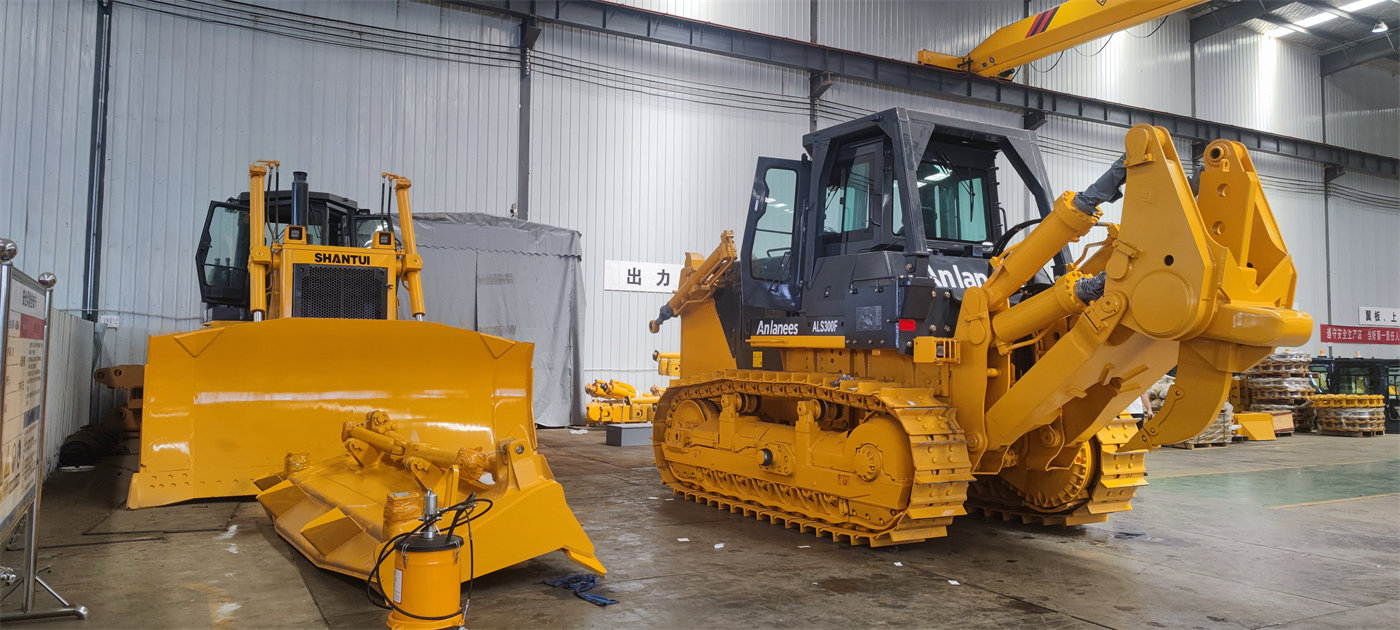
The operating weight is 40900 kg, 400 kg heavier than the coal version, and the ground pressure is 99.4 kPa. The ground pressure values are close, indicating that the two versions have no essential difference in undercarriage load-bearing design; the main differences are in the blade, push arm and wear-resistant configuration. If the bearing conditions of the mine working face are poor, such as in backfill areas or soft ground, whether the 99.4 kPa ground pressure is suitable needs to be verified against on-site soil bearing capacity and rainy-season conditions.
This version can be optionally equipped with a single-shank or three-shank ripper, with maximum ripping depth of 1250 mm for single-shank and 842 mm for three-shank, used for pre-loosening hard soil or weathered rock. Whether the ripper can replace blasting or mechanical breaking depends on rock hardness and integrity; the data does not give the applicable range, so judgment requires on-site testing or geotechnical data.
Overall machine conditions shared by the two versions
The SD32C and SD32W share the same engine platform and drivetrain framework. The SD32C uses the QSNT-C345 engine with rated power of 257 kW/2000 rpm; the SD32W can use WP12 or QSNT-C345 with rated power of 258/257 kW/2000 rpm. Both are marked as meeting China Stage III emission standards. The data does not provide machine configurations corresponding to different emission regions; export projects need separate confirmation of emission compliance requirements.
For the undercarriage, both versions offer track shoe widths of 560/610/660/710 mm, with a track gauge of 2140 mm, track ground contact length of 3150 mm and ground clearance of 500 mm. Track shoe width selection affects ground pressure and passability; wide shoes suit soft ground but may increase steering resistance, while narrow shoes suit hard ground. Which option to choose needs to be combined with site bearing and working face conditions.

The cab is a six-sided enclosed type, with optional FOPS&ROPS safety protection structure and standard high-brightness LED work lights. Whether these configurations are needed for nighttime mine operations or continuous port shifts should be clarified at inquiry. The data does not give cab noise, air conditioning cooling capacity or similar figures, so comfort performance cannot be judged from it.
Conditions to verify before selection
Whether for port bulk material or mine stripping, the following conditions cannot be confirmed on site by the data itself:
- Material characteristics: bulk material particle size, moisture content, bulk density; rock lithology, lump size, weathering degree.
- Site conditions: ground bearing capacity, slope, working face width, rainy-season or wet conditions.
- Work organization: dozing distance, single-shift operating hours, whether multi-shift continuous operation, refueling or energy replenishment conditions.
- Supporting equipment: transport vehicle bed height and capacity, loading equipment interface method, whether ripper pre-loosening is needed.
- Emissions and compliance: emission requirements of the project location, whether export certification is involved.
The data does not give the dozing efficiency, fuel consumption or wear cycle of the two versions under specific material conditions, so per-shift output or operating cost cannot be calculated from the parameters. During selection, the above conditions should be checked item by item with dealers or manufacturer technical personnel, and on-site machine testing should be arranged when necessary.
Information to provide at inquiry
When inquiring with manufacturers or dealers, it is recommended to provide: material type and particle size range, site plan and bearing conditions, dozing distance and working face slope, planned shifts and annual workload, supporting transport vehicle parameters, emission and certification requirements, and whether a ripper or specific blade type is needed. This information helps confirm which version and configuration in the SD32 series is closer to actual needs, and also lets the manufacturer clarify which conditions still require on-site verification.