













A common dilemma in dozer procurement is that the work content includes both pushing and stockpiling loose materials and clearing hard ground, weathered rock, and stony soil. Both types of work look like "pushing," but the actual requirements for blade type, blade wear resistance, overall weight distribution, and ripper matching are different. This article breaks down the work by object, then uses the publicly available information on the SD32 series on this site to explain which needs the configuration differences correspond to, and finally lists the conditions that must be verified before purchase.
First Distinguish the Two Work Objectives
Loose material pushing typically involves coal, sand and gravel, loose earthwork, and bulk materials in stockyards. Its work characteristics are: strong material flow, large single-pass volume, frequent back-and-forth movement; the blade must "hold and carry" the material, and the cutting edge does not need to emphasize penetration into hard objects.
Hard ground clearing typically involves weathered rock, stony soil, crushed stone yard surfaces, and compacted hard soil. Its work characteristics are: the material must first be broken or loosened, the blade must have sufficient penetration capability and structural rigidity, blades wear quickly, and the undercarriage bears more concentrated impact.
These two objectives translate into equipment requirements in terms of blade type, reinforcement of blades and push arms, ripper matching, and matching of undercarriage and travel speed. Discussing them together as "the bigger the better" often leaves shortcomings in one type of work.
Blade Type: Trade-off Between Loading Capacity and Penetration Capability
The blade types listed in the SD32 series data include straight blade, angle blade, semi-U blade, U-blade, as well as the coal push blade dedicated to the coal version, and the rock blade and sanitation blade of the rock version. The differences among these types mainly lie in the blade curvature, side plate height, and width, which directly determine whether it is better at "catching material and carrying it forward" or better at "penetrating and stripping."
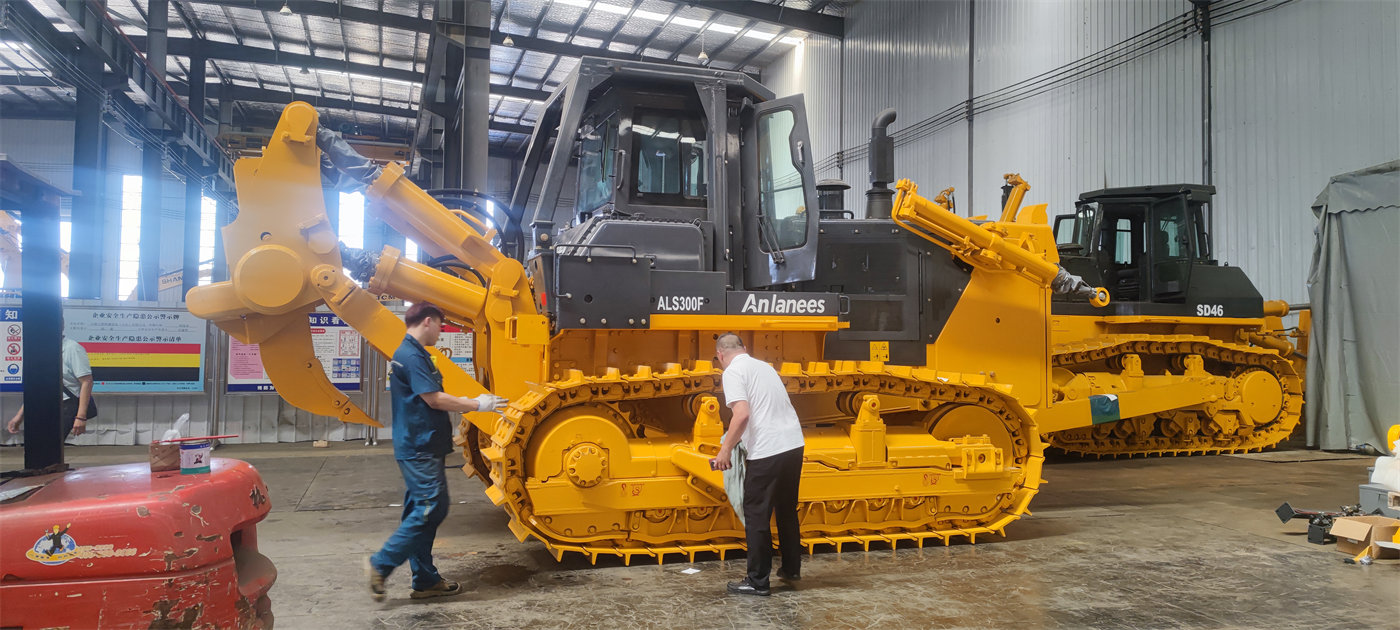
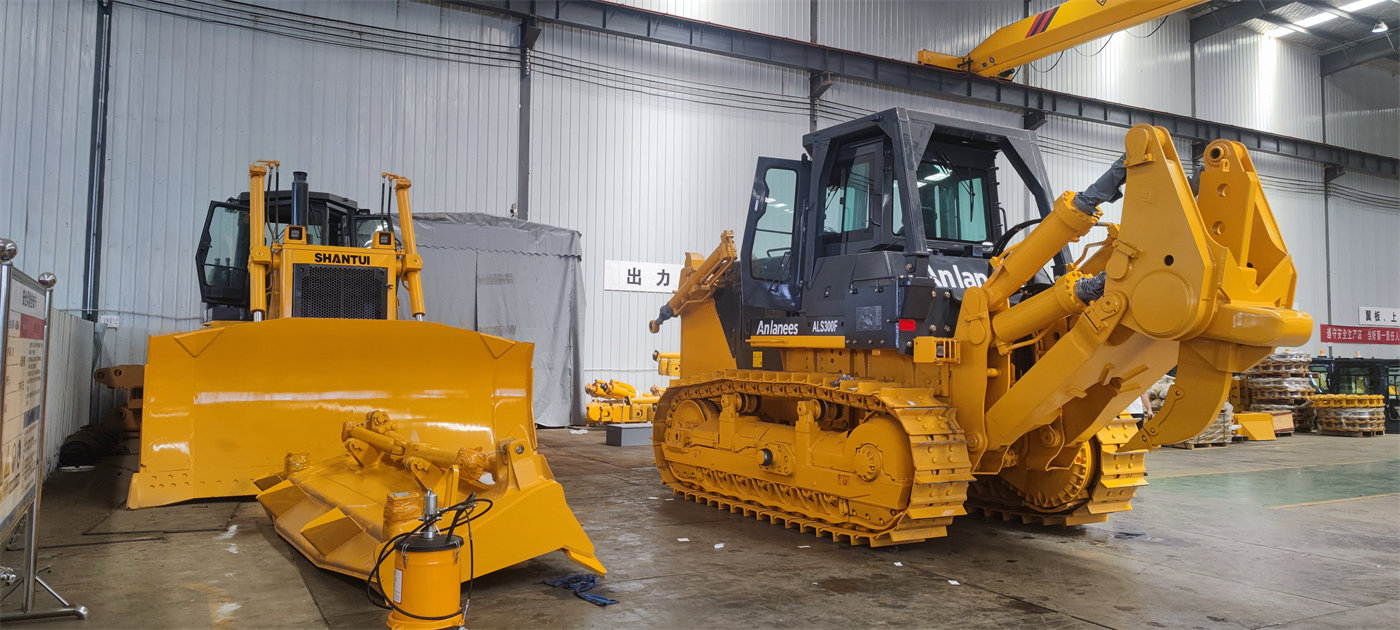
Taking the standard version as an example, the straight blade has a width of 4130 mm and a height of 1590 mm; the angle blade has a width of 5000 mm and a height of 1140 mm; the semi-U blade has a width of 4130 mm and a height of 1710 mm. The semi-U blade and U-blade have higher side plates, providing better constraint for loose materials, suitable for scenarios with large pushing volumes and materials prone to scattering; the straight blade and angle blade have more direct structures, and the angle blade can also adjust its angle for side pushing and slope trimming.
The coal push blade of the coal version SD32C has a width of 4806 mm (semi-U type) or 4520 mm (U type), both with a height of 1710 mm. These dimensions themselves point to large-capacity loose material pushing. The rock blade of the rock version SD32W uses the same three forms: straight, angle, and semi-U, with widths and heights consistent with the standard version. The differences mainly lie in thicker blades, wear-resistant treatment, and reinforced push arm assemblies, rather than changing the blade shape to handle stone conditions.
In other words, the blade type determines how the material flows in front of the blade, while the blade material and push arm structure determine whether it can withstand hard object impact over the long term. If these two things are verified separately during procurement, the judgment will be much clearer.
Ripper and Undercarriage: Hard Ground Cannot Be Judged by Blade Alone
When facing weathered rock, stony soil, or compacted hard layers, cutting with the blade alone is often inefficient; usually a ripper is needed to loosen the material first before pushing. The SD32 series offers single-shank or three-shank rippers. The single-shank has a maximum ripping depth of 1250 mm and a lift height of 955 mm; the three-shank has a maximum ripping depth of 842 mm and a lift height of 883 mm. The single-shank is suitable for concentrated penetration into harder layers, while the three-shank is suitable for broader shallow loosening. The specific choice depends on the thickness and continuity of the hard layer.
Regarding the undercarriage, the SD32 series has a track gauge of 2140 mm, track shoe widths available in 560, 610, 660, and 710 mm, a ground contact length of 3150 mm, and ground pressure between 97.7 and 99.4 kPa (slight differences among versions and configurations). Wider track shoes help reduce ground pressure and provide more stability on soft or wet ground; however, on hard crushed stone ground, the track shoes and track rollers bear more direct impact, which is why the rock version emphasizes reinforced structures.
Regarding travel speed, the data gives forward speeds of F1 0–3.6, F2 0–6.6, F3 0–11.5 km/h, and reverse speeds of R1 0–4.4, R2 0–7.8, R3 0–13.5 km/h. Pushing work is mostly done in low gears; reverse speed affects the cycle time of back-and-forth movement. This is worth considering when comparing different work organization methods, but actual productivity cannot be inferred from it.
Configuration Tendencies by Work Combination
The following table compares the two work objectives with the corresponding configuration directions in the data. It is only a selection approach and does not mean that a certain configuration will necessarily be suitable for a specific job site.
| Work Objective | Blade Focus | Other Matching Focus |
|---|---|---|
| Loose material pushing, stockpiling | Semi-U blade, U-blade, or coal push blade, high side plates, large capacity | Track shoe width, ground pressure, cycle speed |
| Hard ground, weathered rock clearing | Straight blade or rock blade, thicker wear-resistant blades, reinforced push arms | Single-shank or three-shank ripper, undercarriage structural strength |
If the same machine is to alternate between the two types of work, a compromise must be made in blade type and blade wear configuration, and the proportion of main work must be clarified during procurement to avoid limiting the efficiency of the other type of work after configuring the blade for a single condition. The data does not provide actual work efficiency for different blade types; this can only be further confirmed during the inquiry stage based on actual materials and shift arrangements.

Power and Continuous Operation Conditions
The SD32 series is equipped with a WP12 or QSNT-C345 electronically controlled engine, rated power 257 to 258 kW (2000 rpm), compliant with China III emission requirements, fuel tank capacity 640 L, hydraulic tank 97 L. The data mentions large torque reserve for stable operation under heavy loads, and standard high-brightness LED work lights to support day and night construction. For projects with continuous pushing or multiple shifts, fuel supply arrangements and work area lighting conditions need to be planned in advance; this is a site organization issue and cannot be judged solely by equipment parameters.
The cab is a six-sided enclosed structure, with optional FOPS&ROPS safety protection, and key lubrication points are centrally arranged externally. For hard ground and crushed stone conditions, daily inspection of blade edges, push arms, track shoes, and ripper tips for wear is unavoidable work. Whether maintenance access is convenient will affect downtime, and this can be confirmed when inspecting the machine.
Boundary Conditions to Verify Before Purchase
- Material composition and proportions: how much loose material, hard soil, and weathered rock, and whether they are concentrated on the same work face.
- Hard layer thickness and continuity: whether a ripper is needed for prior loosening, and whether single-shank or three-shank is more suitable.
- Ground bearing capacity and moisture conditions: determines the trade-off direction for track shoe width and ground pressure.
- Work organization: single shift or multiple shifts, round-trip distance, and stockpile point layout.
- Attachments and supporting equipment: whether a scarifier, drawbar, and connection with transport and loading equipment are needed.
- Safety and environmental requirements: whether FOPS&ROPS configuration is needed, and whether there are additional regulations on emissions and site management.
Information Recommended to Provide During Inquiry
To make configuration recommendations more practical, the following can be provided during inquiry: main material types and approximate proportions, work face dimensions and pushing distance, thickness of hard layer or rock, site ground conditions, daily shifts and planned work volume, whether ripping and towing work are needed, existing supporting equipment, and requirements for safety protection and emissions. These pieces of information determine the selection direction for blade type, number of ripper shanks, and track shoe width. Without them, only conditional recommendations can be given, and it is impossible to judge whether a certain configuration is truly applicable.