



















In the primary rock breaking stage of medium-sized quarries, the trade-offs in equipment specifications are often more subtle than expected. If the breaker is on the small side, the impact pace cannot keep up when encountering high-density basalt or granite, increasing secondary breaking volume; if the breaker is on the large side, the carrier's hydraulic system flow and pressure may not be able to supply steadily, and the structural components bear greater reaction forces. What really needs to be determined is not "the bigger the better," but the balance point among carrier, attachment, and material that can sustain continuous operation.
First, consider what the crushing stage does in a quarry
Primary rock breaking in a quarry typically handles large blocks after blasting, with the goal of reducing particle size to a range acceptable for subsequent loading or feeding into the crushing station. This stage is characterized by large blocks, hard materials, strong abrasiveness, and often requires continuous impact. The equipment requirements focus on three points: sufficient single-impact energy, stable hydraulic supply, and structural durability under continuous operation.
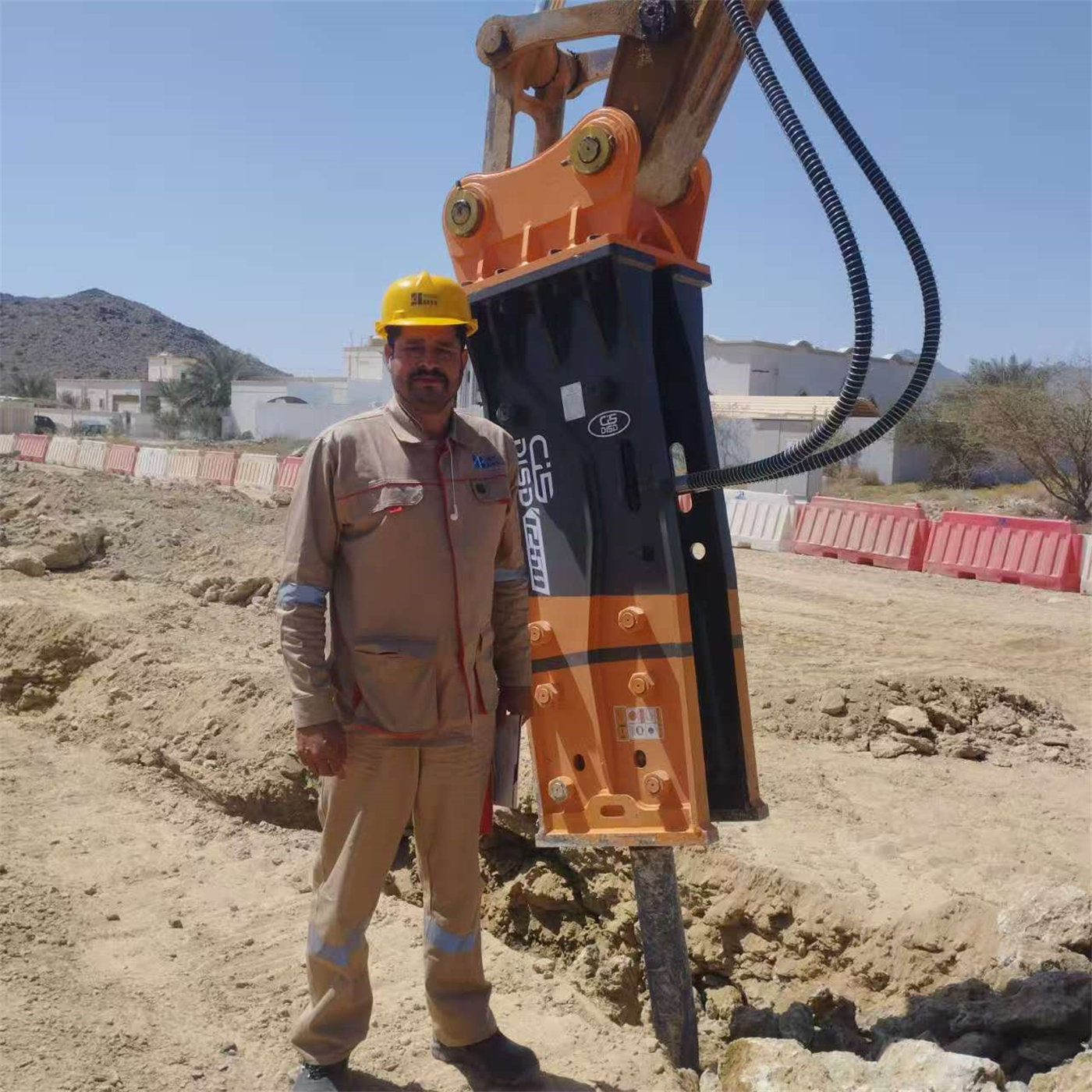
The information on this site positions the ME1650 as a heavy-duty mining hydraulic breaker for 33–38 ton large excavators, with applications including open-pit mining, quarry primary rock breaking, and large-scale infrastructure. This positioning is the starting point for judging the specification balance point, but it does not mean that matching is complete simply because the carrier tonnage falls within this range.
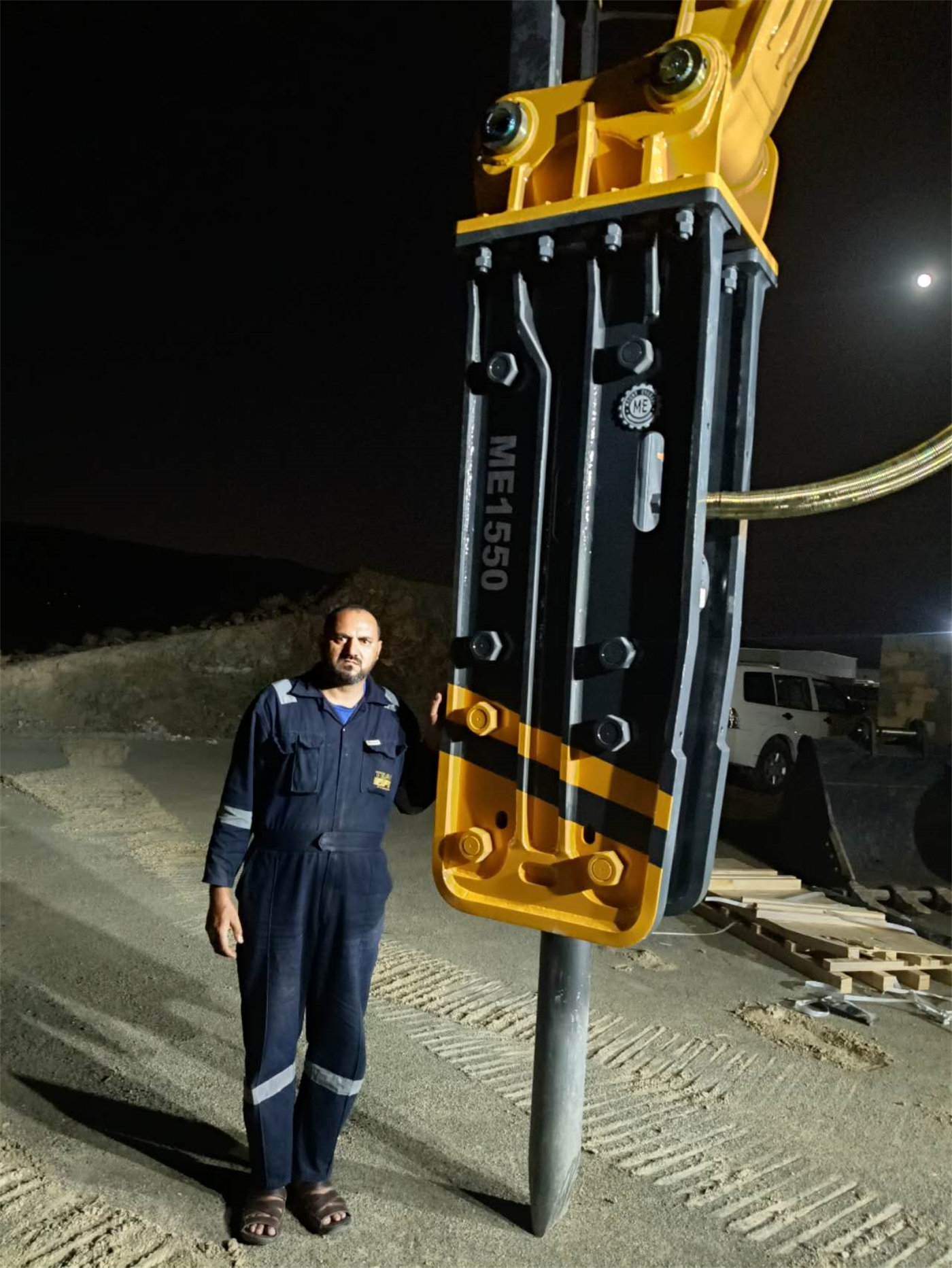
Several items in the ME1650 information related to specification balance
| Item | Data value | Implication for selection |
|---|---|---|
| Applicable carrier | 33–38 ton excavator | First screening condition, not a sufficient condition |
| Operating weight | 3380 kg | Affects carrier counterweight and boom load |
| Hydraulic flow | 200–260 L/min | Must match carrier hydraulic output |
| Operating pressure | 210–220 kg/cm² | Must confirm the carrier can provide stably |
| Chisel diameter | 165 mm | Determines penetration capability and applicable materials |
| Chisel length | 1500 mm | Affects deep breaking and steel bar stress |
This table is not a selection conclusion but a prompt for the verification sequence. The tonnage range is the entry point, flow and pressure are hard constraints on the carrier side, and chisel specifications and operating weight together determine what pace this breaker can achieve on the target material.
Flow and pressure: both numbers must hold simultaneously
The information gives the ME1650 a high hydraulic flow range of 200–260 L/min and an operating pressure range of 210–220 kg/cm². These two factors work together in continuous rock breaking in quarries: flow determines whether the impact frequency can be maintained, and pressure determines the energy level of each impact. If the carrier can only provide flow near the lower limit of the range and the material is high-density hard rock, the actual breaking pace may be lower than expected. Before purchase, verify the carrier's actual output in breaking mode rather than looking only at rated values.
Correspondence between chisel specifications and materials
A forged chisel with 165 mm diameter and 1500 mm length corresponds to deep penetration and hard rock breaking requirements. The information describes it as suitable for high-density rock formations such as basalt and granite and thick reinforced concrete foundations. For medium-sized quarries, this means the specification is more suitable for handling large hard rock blocks after blasting rather than lightweight materials or thin concrete layers. If the on-site material is mainly medium-hardness stone with smaller particle sizes, whether the larger chisel specification is still necessary needs to be re-evaluated based on actual material conditions.
Matching requirements brought by 3380 kg structural weight
An operating weight of 3380 kg means the carrier side needs corresponding counterweight and boom load-bearing capacity. The information mentions that the breaker uses an ultra-rigid reinforced structural chassis and an energy recovery accumulator, with the purpose of maintaining structural stability and suppressing hydraulic pulsation under high-frequency, high-energy impacts. However, this also means that if the carrier tonnage tends toward the lower limit, the load-bearing margin of the boom, stick, and slewing platform during continuous breaking must be confirmed. Whether the tonnage is near 33 tons or near 38 tons, the matching conditions are not the same.
Under what conditions this specification may not be the balance point
- The on-site material is mainly medium-to-low hardness and small particle size, so the penetration advantage of the 165 mm chisel cannot be fully utilized, and the breaking volume per unit time may not be better than a smaller specification.
- The carrier's hydraulic system actual output is consistently below 200 L/min; insufficient flow will reduce the impact pace, and in this case the carrier should be verified first rather than forcing a breaker match.
- Operations are mainly intermittent and small-batch breaking; the counterweight adjustment and relocation burden brought by the 3380 kg operating weight may not be cost-effective.
- The quarry bench height or site space is limited; the 1500 mm long chisel and the overall dimensions impose additional requirements on positioning and slewing.
These are not judgments denying the specification but indicate that "medium-sized quarry" itself covers a wide range, and the specification balance point must be determined in conjunction with annual output, material hardness, and the carrier's actual configuration.

Items requiring written confirmation before purchase
The information provides parameters on the breaker side, but the matching between carrier and attachment also involves several conditions not reflected in this article's information. The following items should be confirmed in writing with the manufacturer or carrier supplier during the inquiry stage:
- The actual flow and pressure curves of the target carrier's hydraulic pump in breaking mode, and whether they cover the 200–260 L/min and 210–220 kg/cm² ranges.
- The correspondence between the breaker connection dimensions and the carrier's stick and linkage pins.
- Pipeline interface specifications, whether the breaking circuit is pre-reserved, and the flow distribution method.
- The counterweight adjustment plan and overall stability calculation after installing the 3380 kg attachment on the carrier.
- Hydraulic oil temperature control and heat dissipation conditions under continuous operation shifts.
Site information to provide during inquiry
To enable the manufacturer to give verifiable matching advice, it is recommended to state during the inquiry: the main rock types and typical block size after blasting at the quarry, average daily breaking volume and shift arrangements, the proposed carrier model and tonnage, existing hydraulic system parameters, bench height and working space, and whether underwater or confined-space operations are involved. The more specific this information is, the better it can be judged whether the ME1650 specification falls at the actual balance point, rather than making a decision based solely on the tonnage range.