


















Demolition work and mine crushing are often discussed together in construction planning because both require hydraulic breakers. However, directly applying the same attachment approach from one type of site to the other often leads to problems with impact rhythm, carrier load, or tool wear. Small-scale demolition deals with reinforced concrete, masonry, and shallow foundations, with scattered work points and relatively short continuous breaking time; medium-scale mine crushing deals with large hard rock blocks after blasting or secondary reduction, with high material hardness and long continuous operation time. The constraints that the two types of demand impose on attachment specifications and carrier matching are not the same.
Focusing on this difference and drawing on the publicly available information on the ME680 hydraulic breaker from this site, this article explains which conditions need to be examined separately in attachment selection between small-scale demolition and medium-scale mine crushing.
Requirements for attachments in the two types of work start with separating material and rhythm
Materials at demolition sites are mainly concrete components, brick-concrete structures, and some reinforced concrete. The breaking goal is usually to dismantle the structure or reduce large concrete pieces to a size suitable for removal. The work face may be close to existing buildings, bridge piers, or underground pipelines, so carrier positioning and breaking direction are restricted, and continuous impact time is often interrupted by structural exposure, rebar cutting, and removal.
Materials in medium-scale mine crushing are mostly hard rock blocks after blasting, harder than ordinary concrete. The goal of secondary breaking is to reduce large blocks to the feed or loading requirements of the crusher. Sites usually require the attachment to sustain relatively long continuous impact, and the carrier hydraulic system must also supply stably.
These two rhythm differences directly affect the attachment's weight class, chisel diameter, and flow matching on the carrier side.
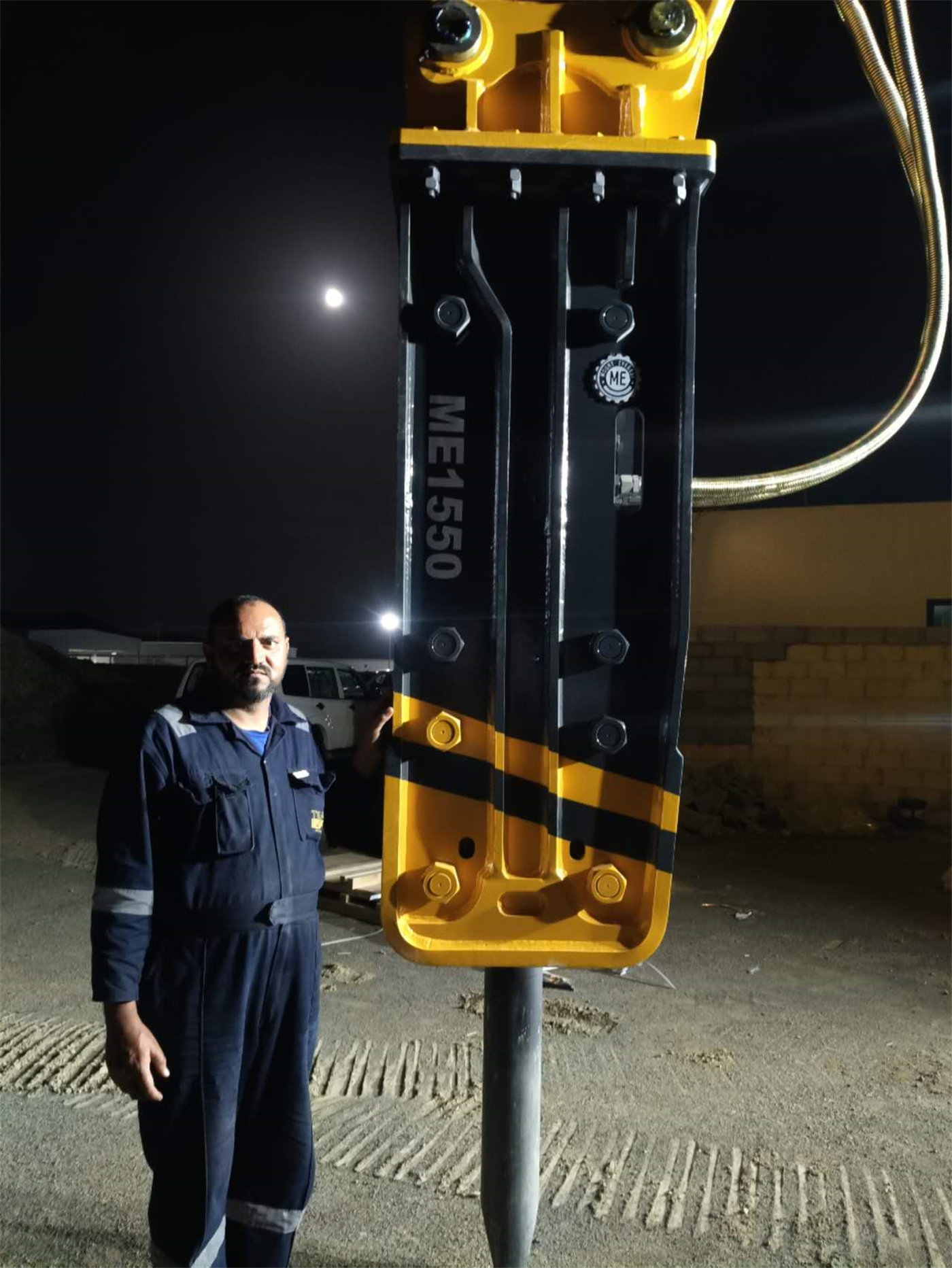
Several conditions in the ME680 information relevant to the two types of demand
The publicly available information on the ME680 hydraulic breaker from this site shows that the attachment uses a 68 mm heat-treated alloy chisel, has a body weight of 300 kg, is suitable for 7–10 t excavators, has a hydraulic flow range of 40–70 L/min, and an operating pressure of 110–140 kg/cm². The application scenarios listed in the information include reinforced concrete demolition, quarry rock breaking, road construction, foundation excavation, utility trenching, and site clearing.
From this information, the ME680's application range spans both small-scale demolition and medium-scale mine crushing. But "spanning" does not mean the same matching approach can be used at both types of sites. What needs to be checked separately is whether the carrier tonnage falls within the 7–10 t range, whether the hydraulic system can stably output a flow of 40–70 L/min and a pressure of 110–140 kg/cm², and whether the on-site continuous operation duration will make heat dissipation and hydraulic oil temperature on the carrier side limiting conditions.
Correspondence between carrier tonnage and attachment weight
The ME680's 300 kg body weight corresponds to 7–10 t excavators. This tonnage range means the carrier's own hydraulic power and structural dimensions are limited, and the relationship between attachment weight and the carrier's rear counterweight needs to be checked in advance. If the carrier tonnage is below the lower limit of the range, installing the breaker may result in insufficient overall machine stability; if above the upper limit, flow and pressure may exceed the attachment's operating range.
Carriers at small demolition sites are often on the small side, so selection should first confirm whether the carrier truly falls within the 7–10 t range; if a larger-tonnage carrier is planned to carry the ME680 in medium-scale mine crushing, it is not enough to check only whether "the breaker can be mounted"—it is also necessary to check whether flow and pressure fall within the 40–70 L/min and 110–140 kg/cm² ranges. When out of range, the attachment's impact rhythm and seal life may be affected.
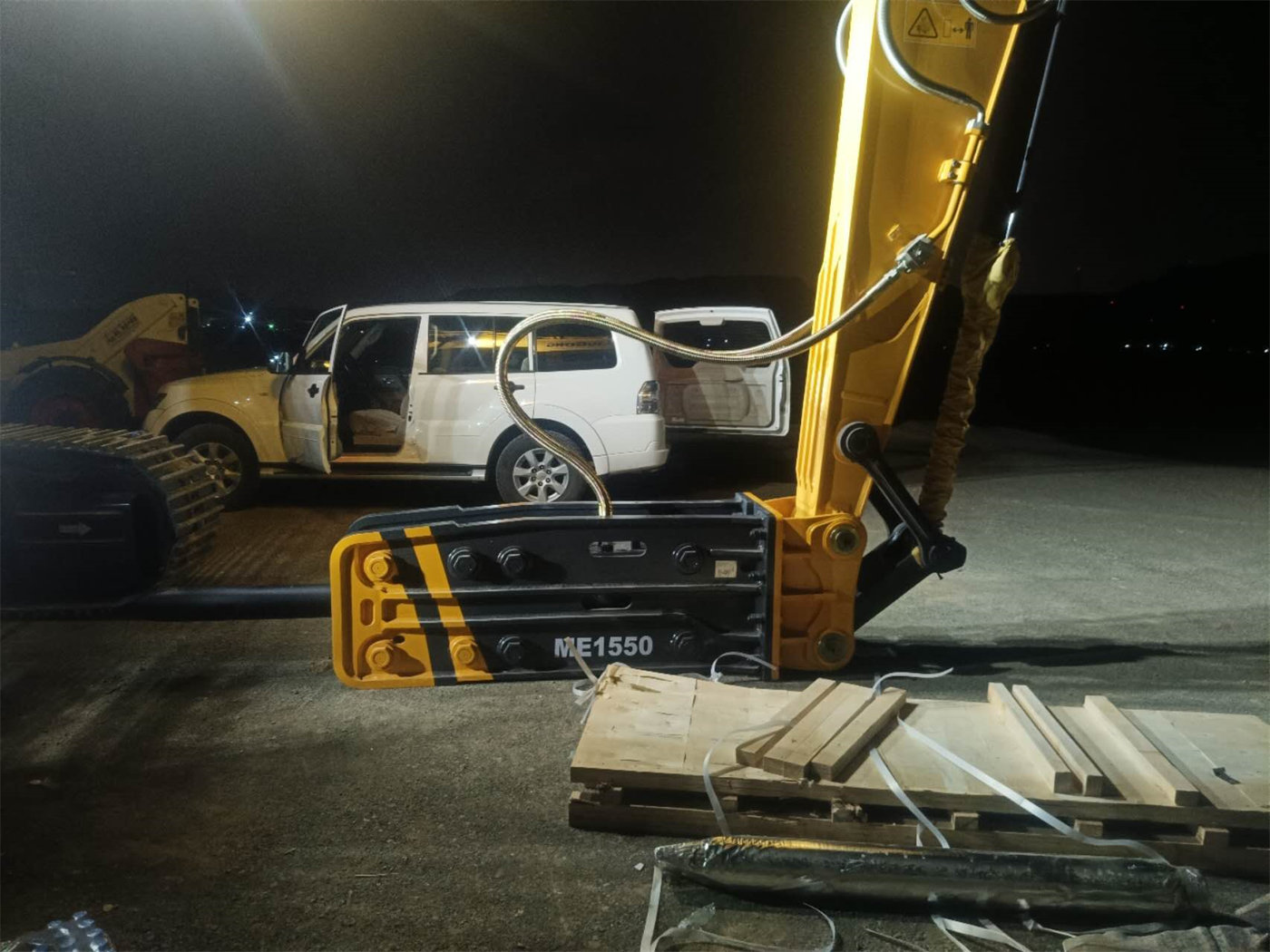
Matching boundary between chisel diameter and material hardness
A 68 mm chisel is a medium specification. In reinforced concrete demolition, this diameter can handle wall and floor components of common thickness; when encountering large-volume foundations or high-grade concrete, breaking efficiency will be limited by the chisel diameter. In medium-scale mine crushing, a 68 mm chisel facing harder rock blocks is more suitable for secondary reduction or for use in combination with other crushing stages, rather than replacing a larger-specification attachment for the main crushing task.
The information states that the chisel undergoes multi-stage heat treatment, balancing surface hardness and core toughness. This addresses the tool life issue under continuous impact, but it cannot be inferred from this that it will maintain the same life under any material hardness. Material hardness, joint development, and operating method will still significantly affect chisel wear rate.
What additional checks are needed under continuous operation conditions
The information mentions that the ME680 is equipped with a large-capacity accumulator buffer to absorb hydraulic peaks and compensate for circuit pressure fluctuations; a precision valve assembly to manage a flow of 40–70 L/min; and a cylinder core with a mirror-polished inner bore to reduce friction and heat accumulation. These structural designs are related to continuous breaking operation, but whether stable operation can actually be achieved also depends on the condition of the carrier hydraulic system, hydraulic oil cleanliness, and heat dissipation conditions.
In small demolition work, continuous impact time is short with many intervals, so the carrier hydraulic system has more cooling opportunities; if medium-scale mine crushing is arranged for long continuous operation, it is necessary to confirm whether the carrier's hydraulic oil heat dissipation capacity, tank capacity, and filter maintenance cycle can keep up. Attachment information will not perform this confirmation on the carrier side.

In which cases this attachment approach needs to be re-evaluated
- The carrier tonnage is not within the 7–10 t range, or the hydraulic flow and pressure deviate from the 40–70 L/min and 110–140 kg/cm² ranges;
- The mine crushing material hardness is noticeably high, and the attachment is required to perform the main crushing task rather than secondary reduction;
- The demolition site contains large amounts of high-grade, large-volume concrete, and the breaking capacity of the 68 mm chisel may be insufficient;
- The site requires long continuous impact, but the carrier's hydraulic heat dissipation conditions have not been confirmed;
- The attachment connection dimensions, pins, and hose interfaces have not been checked against the carrier's actual configuration.
Items recommended to be confirmed in writing before purchase
The ME680 information provides the applicable tonnage, flow, pressure, and chisel specifications, but whether the carrier and attachment match also involves connection dimensions, pin diameter, arm and boom front-end structure, hydraulic hose interface type, and control valve configuration. These items may differ across carriers, and each must be confirmed after providing the manufacturer with the carrier model, hydraulic system parameters, and attachment mounting interface information.
The application scenarios listed in the information are product application range descriptions and do not mean that a particular carrier, once equipped, will necessarily achieve a certain construction result at a specific site. Material condition, operator skill, and site organization all affect actual performance, and judgment should be made based on specific working conditions before purchase.
Site information to provide when requesting a quote
Whether facing a demolition or mine crushing project, when requesting a quote it is recommended to state: material type and approximate hardness, individual material size, planned daily breaking volume, carrier model and tonnage, hydraulic flow and pressure parameters, attachment mounting interface type, work shifts and continuous operation duration, and on-site power or maintenance conditions. This information helps the manufacturer determine whether the ME680 falls within the applicable range and what additional matching information is needed.