















In deep pit operations, equipment specifications are often treated as direct proof of capability: the deeper the pit, the higher the bench, and the heavier the material, the more tonnage and bucket capacity should be added. This judgment is only half right. Specification scaling can indeed cover a larger single-cycle workload, but it also brings constraints in site access, haulage, supporting equipment and operational organization. This article answers: in the specific scenario of deep pits, where are the specification boundaries of ultra-heavy excavators, which parameters truly correspond to deep-pit operational needs, and which conditions must be determined before specifications.
What requirements do deep pits impose on equipment that differ from surface mining sites?
The operational characteristics of deep pits can be broken down into several verifiable requirements rather than a vague "heavy load":
- Operations are deep inside the pit, and the equipment must complete excavation, swing and dumping within limited space; the working range directly determines whether the material can be reached from a safe standing position.
- Benches and slopes coexist, and travel stability, traction and gradeability affect the controllability of equipment movement within the pit.
- Material must be loaded into haul trucks; the relationship between bucket capacity, truck body capacity and loading point height affects whether the loading rhythm is smooth, rather than simply bucket size.
- Long-term continuous cyclic operation imposes sustained requirements on engine power reserve, undercarriage structure and track ground contact conditions.
These requirements do not automatically translate into "choose the largest specification." Specification selection needs to be checked item by item against the data.
The benefits and costs of specification scaling must be considered together
The advantages of ultra-heavy mining excavators are concentrated in large single-cycle workload, high penetration capability and wide coverage, making them suitable for large-scale bulk excavation and extreme open-pit mining. The corresponding costs are significantly increased whole-machine weight, dimensions and transport organization difficulty, along with the need to match haul trucks, loading point layout and in-pit access routes.
Therefore, the part where "the bigger the better" does not hold is: if truck body capacity, loading point height or in-pit access cannot accommodate large-specification equipment, the specification advantage will be offset by supporting bottlenecks; if the material is mainly loose earthwork, ultra-large bucket capacity is not the only solution. Conversely, in deep pits with high benches, hard materials and distant loading points, insufficient specifications will directly limit the working range and loading connection. The judgment basis should rest on specific working condition parameters.
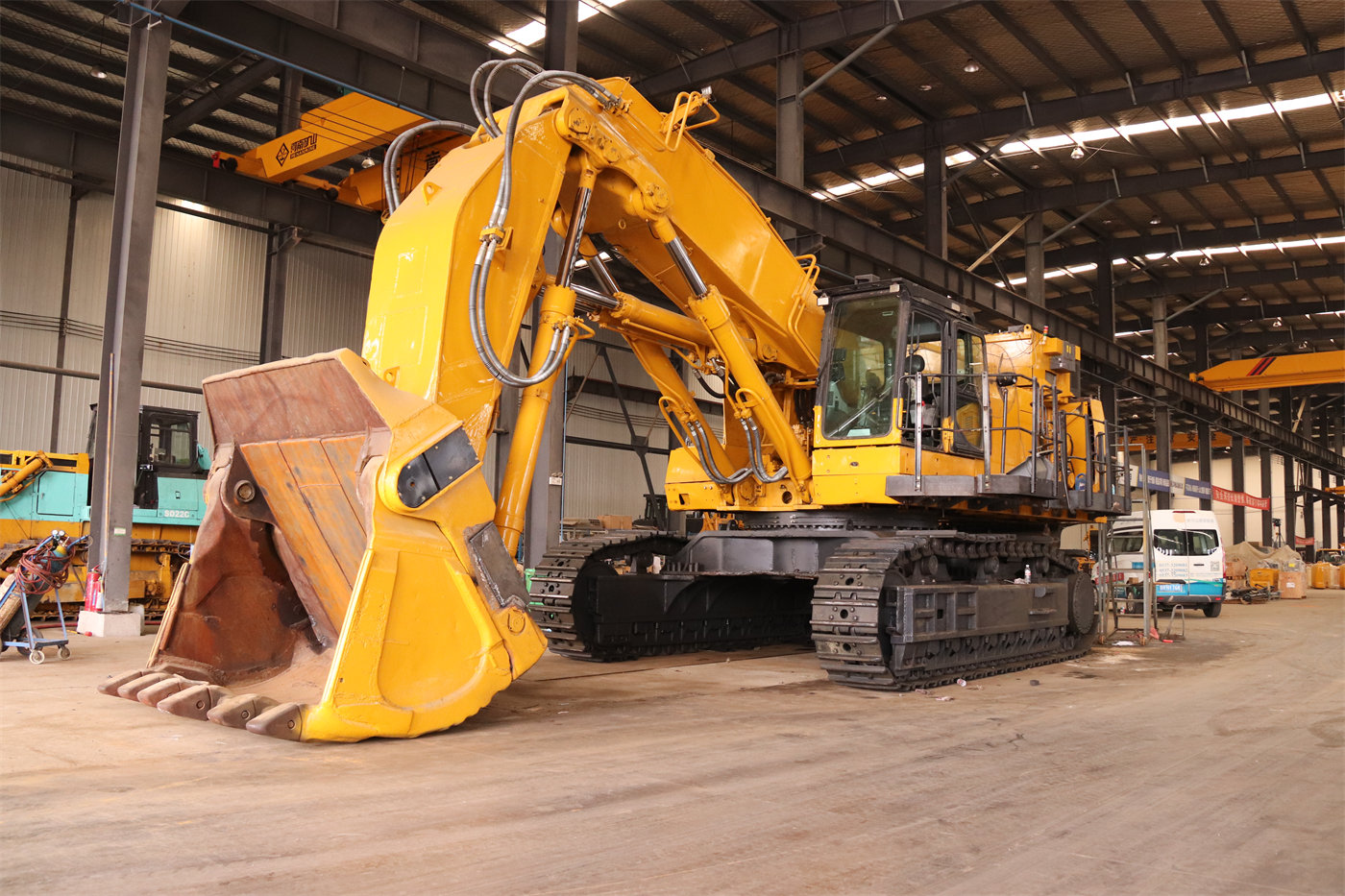
Taking a 120-ton-class ultra-heavy mining excavator as an example, what can the data show?
The following analysis is based on verified product information from this site and is only used to explain the correspondence between specifications and deep-pit needs; it does not mean that this model is suitable for all deep pits.
Engine power and continuous cycling
This model has an operating weight of 120000 kg and is equipped with a Weichai 8M33 engine with a displacement of 26.1 L and a rated power of 680 kW (approximately 912.7 HP, at the data-listed speed of 1800 r/min). In continuous high-intensity cycling in deep pits, power reserve affects whether the hydraulic system can maintain stable action speed. The data describes it as a mining-grade power unit, emphasizing high torque reserve to support continuous operation, which is one of the bases corresponding to the need for "heavy-load continuous cycling."
Bucket capacity and digging force
Bucket capacity is 7.5–10 m³, bucket digging force is 610 kN, and stick digging force is 532 kN. Large bucket capacity corresponds to single-load volume, while digging force corresponds to hard-material penetration capability. These two must be viewed together: after bucket capacity is enlarged, if material hardness increases, the digging resistance per bucket also increases; the 610 kN digging force is a reference item for judging whether this model can cut into hard rock, but the data does not provide construction conclusions for specific rock conditions, and actual applicability still needs to be confirmed against on-site materials.
Working range and deep-pit standing position
This model has a maximum digging radius of 13875 mm, maximum digging height of 12480 mm, maximum digging depth of 8165 mm, and maximum dumping height of 8065 mm. For deep pits, a larger digging radius means the equipment can complete material pickup at a position relatively far from the pit wall, reducing frequent repositioning; dumping height relates to whether material can be delivered into haul trucks. The original data mentions that this coverage facilitates safer operation and long-distance material handling in deep pits. It should be noted that these are the upper limits of the equipment's own working range; the actually usable dumping height also depends on truck dimensions and loading point layout.
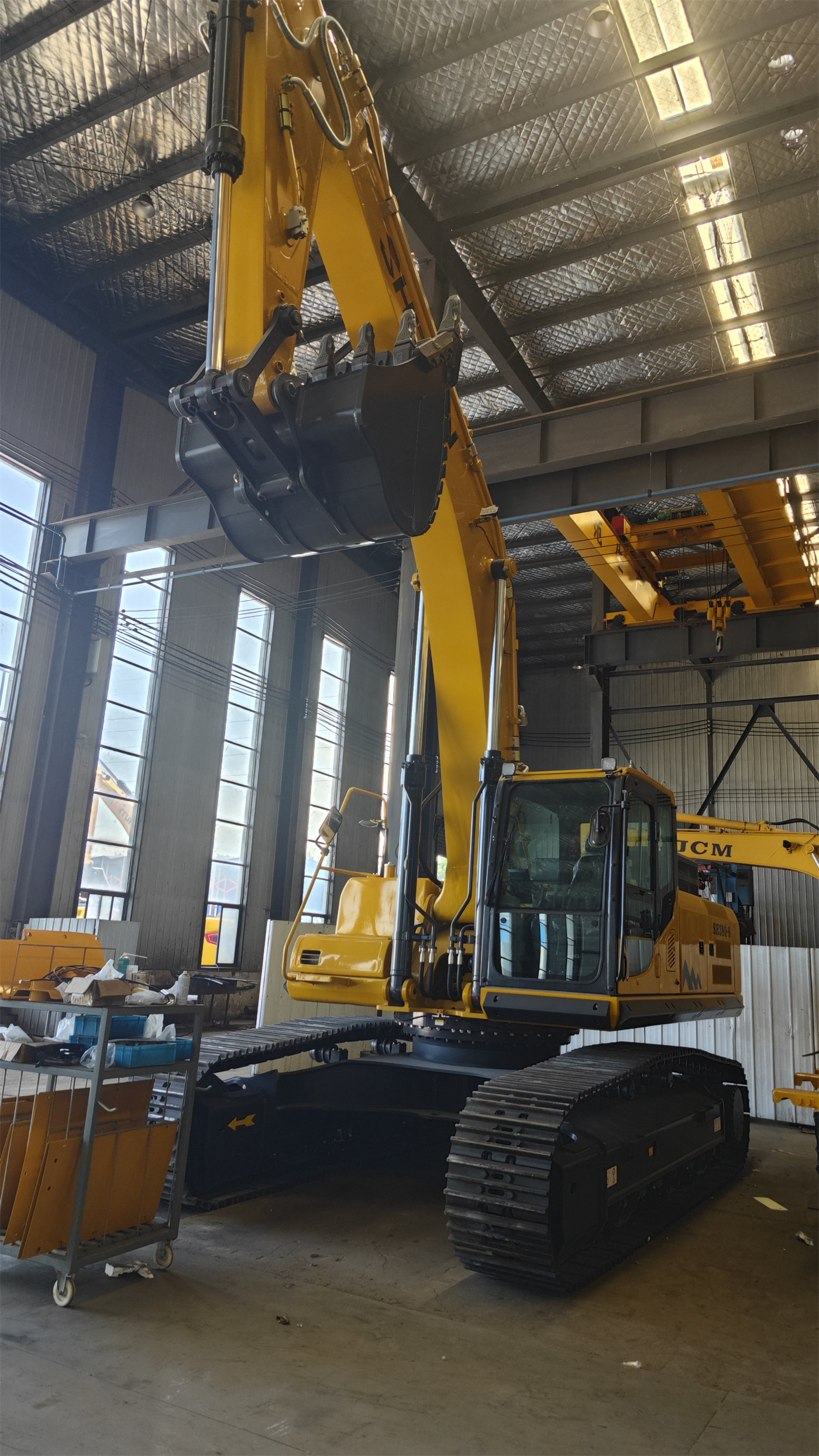
Undercarriage and slope stability
The overall width is 5385 mm, track gauge is 3900 mm, total track width is 4600 mm, standard track shoe width is 700 mm, ground pressure is 147 kPa, traction force is 745 kN, and gradeability is 70% (35°). The ultra-wide undercarriage and reinforced track system provide the stability foundation for heavy-load working conditions. When moving on deep-pit slopes, traction and gradeability determine whether the equipment can travel stably when fully loaded or empty; ground pressure relates to the risk of sinking on soft or poorly compacted ground. This part needs to be compared with on-site ground bearing conditions; the data itself does not constitute a guarantee of applicability to specific ground.
Mobility parameters
Swing speed is 5.5 r/min, and travel speed is 2.4/3.5 km/h. Swing speed affects the rhythm of a single cycle, but the loading rhythm is jointly determined by digging, swinging, dumping and truck repositioning, so efficiency cannot be judged by this item alone.
Before choosing this type of specification, what supporting conditions still need to be confirmed?
Equipment parameters are only part of the judgment. In deep-pit scenarios, it is recommended to check simultaneously:
- Whether haul truck body capacity and body height match the 7.5–10 m³ bucket and the 8065 mm maximum dumping height;
- Whether in-pit access width, turning radius and bench slopes meet the passage conditions for the 5385 mm overall width, 5100 mm tail swing radius and 35° gradeability;
- Whether ground bearing and drainage conditions at the loading point are consistent with the 147 kPa ground pressure;
- The organization of fuel supply, maintenance access and spare parts supply within the pit;
- Material hardness and lump size distribution, to confirm the working states corresponding to the 610 kN bucket digging force and 532 kN stick digging force;
- The equipment site access transport plan, including the possibility of disassembled transport and road width/weight limits.
If any of the above conditions cannot be met, the advantages of large-specification equipment may not be realized and may even bring additional operational organization difficulty. The data does not provide specific matching conclusions for these supporting items and needs to be verified against actual project conditions.

Conclusion: specifications are conditional, not one-dimensional
Whether a deep pit should choose an ultra-heavy excavator depends on whether the working range is limited, whether the material is hard enough, whether haulage support can keep up, and whether in-pit access and ground conditions allow it. The data for this 120-ton-class model provides a basis corresponding to deep-pit heavy-load needs in power, bucket capacity, digging force, working range and undercarriage configuration, but the data also shows that these capabilities have clear boundaries and cannot be summarized as "suitable for all deep pits." The premise for increasing specifications is that supporting conditions are established simultaneously.
Information recommended to prepare before inquiry
If this model needs to be checked for a specific deep-pit project, it is recommended to organize the following information:
- Pit depth, bench height, slope angle and working face dimensions;
- Material type, hardness, lump size and loosening factor;
- Daily/shift workload and continuous shift arrangements;
- Supporting haul truck model category, body capacity and body height;
- In-pit access width, turning conditions and ground bearing conditions;
- Power supply or fuel supply conditions and maintenance site arrangements;
- Road width limits, weight limits and disassembly conditions for equipment site access transport.
Matching conclusions not covered by the data need to be further confirmed after obtaining the above information; it is not advisable to draw conclusions directly based only on tonnage or bucket capacity.